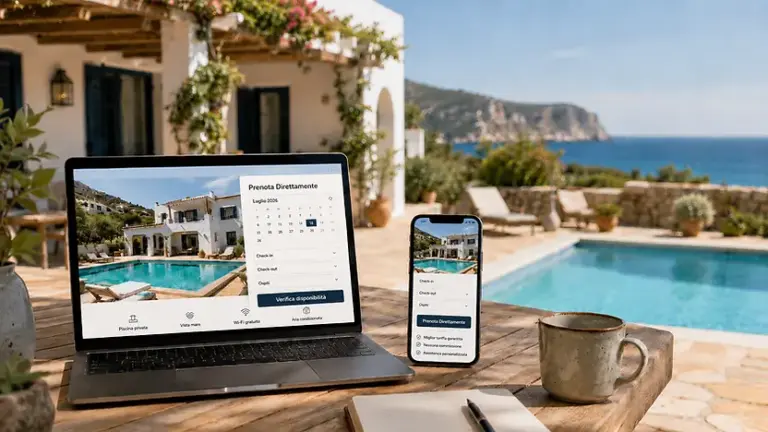

The Airbnb fees represent an important distribution cost for holiday homes, B&B and accommodation facilities.
With the structure Single Fee, Airbnb indicates that the entire fee is subtracted from the host’s payout, and that most affected hosts pay the 15,5%, while for others the percentage is generally between 14% and 16%.
This means that as the number of bookings received through the platform increases, the amount paid in commissions also increases proportionately.
But there is a fundamental point to clarify:
you don’t need to stop using Airbnb to reduce your reliance on Airbnb fees.
The strategy can be much simpler:
continue to use Airbnb to gain visibility and, at the same time, build your own direct booking channel.
Let’s see how.
Can Airbnb fees really be reduced?
Two concepts must be distinguished.
You can’t decide for yourself to pay a lower percentage on a reservation made through Airbnb.
However, you can make sure that a greater share of your future bookings are generated through other channels, for example:
- proprietary website;
- Google;
- Google Business Profile;
- social networks;
- advertising campaigns;
- word of mouth;
- SEO organic traffic;
- Booking Engine installed on your site.
This means that Airbnb continues to be one of your sales channels, but not necessarily the only one.
And this is the real difference between:
reduce your Airbnb fee
e
reduce the impact of Airbnb fees on your business.
How much do Airbnb fees affect?
Let’s take an example using a commission of the 15,5%.
Airbnb itself uses 15.5% in its Single Fee examples and explains that, maintaining a price of 100, the payout after the commission would be 84.50.
Mathematically applying 15.5%:
| Booking volume | Theoretical fee 15.5% |
|---|---|
| €5,000 | €775 VAT included |
| €10,000 | €1.550 VAT included |
| €20,000 | €3.100 VAT included |
| €30,000 | €4.650 VAT included |
| €50,000 | €7.750 VAT included |
| €75,000 | €11.625 VAT included |
| €100,000 | €15,500 |
Of course, the commission actually applied to the individual host can be different.
But these numbers allow us to understand why, as turnover increases, it becomes increasingly interesting to build a proprietary channel as well.
You don’t have to move all bookings to your site
This is probably the most common mistake when it comes to direct bookings.
The goal should not necessarily be:
“From tomorrow I no longer use Airbnb.”
Airbnb can bring visibility and customers who probably would never have discovered your property on their own.
A more realistic strategy could be:
- 70% OTA;
- 30% direct bookings.
Or:
- 50% OTA;
- 50% direct.
Each structure will have a different balance.
However, gradually shifting the weight of distribution can also have significant effects.
Example: A facility that generates €30,000 per year
Let’s say that a vacation rental annually generates:
€30,000 bookings.
If the entire volume were hypothetically subject to a 15.5% commission, we would have:
€4.650 VAT included
of commissions.
Now let’s imagine that the owner progressively develops a site capable of generating new demand on its own.
10% through the site
Direct bookings:
€3,000
15.5% of €3,000 is equivalent to:
€465 VAT included
20% through the site
Direct bookings:
€6,000
Mathematical equivalent of 15.5%:
€930 VAT included
30% through the site
Direct bookings:
€9,000
Equivalent:
€1.395 VAT included
50% through the site
Direct bookings:
€15,000
Equivalent:
€2.325 VAT included
This does not mean that direct booking is completely free.
However, there are costs such as:
- hosting;
- domain;
- Booking Engine;
- payment gateway fees;
- any advertising;
- site management.
But the key difference is that you’re also investing in building A channel that belongs to your business.
Direct booking doesn’t have to replace Airbnb—it has to go with it
A more effective way of thinking is to consider Airbnb as an acquisition channel.
Airbnb can intercept a tourist who is looking for:
“Holiday home Rome center”
and who has never heard of your facility.
The owning site can instead intercept:
- those who search directly for the name of the structure;
- those who come from Google;
- those who find the property on Google Maps;
- those who come from Instagram;
- those who click on an advertising campaign;
- those who receive the link through word of mouth;
- Who finds an article on your site on search engines.
The strategy then becomes:
Airbnb for distribution + website to build a proprietary channel.
Warning: you must not move a reservation born on Airbnb outside Airbnb
It’s important to distinguish a true direct booking strategy from circumventing platform rules.
Airbnb prohibits hosts from asking a guest to move an Airbnb reservation off-platform, and its policy also covers attempting to take current, future, or repeat bookings resulting from the relationship created through Airbnb off-platform.
So the correct strategy is not:
“The client found me on Airbnb, I write to him on WhatsApp and tell him to book on my website.”
The correct strategy is to build An independent source of direct demand:
Google → your → Booking Engine →booking site
or:
Instagram → your →booking site
or:
Google Business Profile → → booking site
Airbnb remains Airbnb.
Your direct channel must be developed in parallel.
1. Create a proprietary website
The first element needed to increase direct bookings is to have an online space controlled by the property.
Not a Facebook page.
Not just an Instagram profile.
And above all, not a page that refers exclusively to the Airbnb listing.
We need a real Proprietary website.
For example:
The site becomes the central point of the online presence of the structure.
It can be used on:
- Google;
- Google Business Profile;
- Instagram;
- Facebook;
- TikTok;
- WhatsApp;
- business cards;
- QR code;
- promotional materials;
- Google Ads campaigns;
- Meta Ads campaigns.
All of these channels can lead visitors to a page that you control directly.
2. It is not enough to have a website: it must be possible to book
Here comes the problem of many accommodation sites.
The customer enters the site.
Look at the photographs.
Read the description.
He likes the apartment.
Then find:
“Book on Airbnb”
and is sent back to the OTA.
The path becomes:
Google → your site → Airbnb → booking
In this case, the site is generating traffic, but it is not really generating a direct booking.
A site designed to convert should instead work like this:
Google → site → availability → price → reservation
To achieve this result, a Booking Engine.
3. Install a Booking Engine
The Booking Engine is the system that allows you to receive reservations through the site.
The customer should be able to:
- choose check-in and check-out;
- select the number of guests;
- check availability;
- view the price;
- enter your data;
- make an enquiry or reservation;
- possibly pay online;
- receive confirmation.
The process should be as simple as possible.
The more steps you force the user to take, the greater the risk of them leaving the site.
4. Already have WordPress? You can turn the site into a booking channel
You don’t need to rebuild an existing WordPress site from scratch.
With Host Domination Booking Engine You can add a booking system directly to WordPress.
The site can thus go from:
Showcase site
a:
site with direct booking.
Host Domination Booking Engine allows you to manage your availability calendar and connect it to external calendars via iCal synchronization.
This allows you to continue to use the following at the same time:
Airbnb + Booking.com + owner website
without necessarily having to choose just one channel.
5. Sync Airbnb, Booking.com, and website
One of the obstacles that hosts are most concerned about is the risk of overbooking.
If a date is booked on the site, in fact, it must also become unavailable on other channels.
One solution used in the industry is synchronization via iCal.
One possible ecosystem becomes:
Airbnb ↔ Booking Engine ↔ Booking.com
When a reservation is received, dates can be shared through the connected calendars.
However, it should be remembered that iCal synchronization is not necessarily instantaneous and has limitations compared to a Channel Manager with API connections.
For a small property or for those who want to start developing direct bookings without immediately adopting more complex software, it can still be a very useful solution.
6. Get found on Google
Having a website does not automatically mean receiving bookings.
Traffic is needed.
And this is where the SEO for vacation rentals.
The site can create pages and content dedicated to research such as:
- holiday home in Rome;
- apartment near the Colosseum;
- where to stay in Fiumicino;
- holiday home near Fiumicino airport;
- apartment with parking in Rome;
- where to stay near [attraction];
- what to see in [location];
- How to get to [attraction]
The goal is to intercept people who are still choosing where to stay.
Each visit generated organically by the site represents a chance to receive a reservation without depending exclusively on the visibility provided by OTAs.
7. Optimize Google Business Profile
For an accommodation facility, Google can become one of the main points of contact with the customer.
A user could:
- search for the name of the structure;
- find the Google tab;
- see photographs and reviews;
- visit the website;
- check availability;
- book.
It is therefore important that the proprietary site is clearly linked to the Google presence of the property, when applicable.
If the visitor is specifically searching for your business name, the goal should be to make it easy for them to find Your official website.
8. Take care of the brand of the structure
Direct bookings become much more difficult if the property does not have a recognizable identity.
Let’s compare:
“Apartment Rome 12345”
with:
“Domus Colosseo Rome”
In the second case, the name is much simpler than:
- remember;
- search on Google;
- share;
- insert on social networks;
- join a domain.
A recognizable brand makes it easier to build an independent channel over time.
9. Make the direct price competitive
A user is unlikely to book directly if the official website costs significantly more than an OTA.
The host should then monitor:
- price displayed on the site;
- price displayed on Airbnb;
- price displayed on Booking.com;
- any additional costs;
- cancellation conditions;
- Services included.
You don’t necessarily need to make huge discounts.
The direct channel can also become more interesting by offering conditions or services consistent with one’s commercial strategy, in compliance with the agreements and rules applicable to the different channels.
10. Make the Booking Engine simple to use
One advantage of large OTAs is simplicity.
The customer already knows the process.
A facility’s site must therefore avoid complicated procedures such as:
“Fill out the form and we will get back to you within 48 hours.”
If possible, it is much more effective to show immediately:
Check-in → Check-out → Guests → Availability → Price → Book
The customer must have a clear answer.
11. Accept online payments
One of the factors that makes a direct booking more professional is being able to complete the payment online.
A Booking Engine can integrate payment systems such as Stripe or other supported solutions.
This reduces the distance between the OTA process and that of the proprietary site.
The customer must not:
- send emails;
- wait for bank details;
- telephone;
- wait for manual confirmations.
You can complete your booking directly.
12. Use Instagram and social media to bring users to the site
Many businesses use Instagram almost exclusively as a photo gallery.
But the social network should have a goal.
For example:
Instagram → →booking site
In bio you can direct users to the official website.
The same goes for advertising campaigns and organic content.
Instead of paying a Meta campaign to send a user to your Airbnb page, you can consider bringing them directly to your site.
You’re paying to acquire traffic: It makes sense to try to turn it into a contact or booking within your ecosystem.
13. Measure where bookings come from
To really reduce dependence on OTAs, we need to measure.
Every month you should know at least:
- Airbnb turnover;
- turnover Booking.com;
- direct turnover;
- number of bookings per channel;
- average booking value;
- commissions paid to OTAs;
- site costs;
- advertising costs;
- cost of acquiring direct bookings.
At that point you can calculate something very important:
Direct booking rate
For example:
Total bookings: €30,000
Bookings from the website: €6,000
The direct fee is:
20%.
The following year you could increase it to 25% or 30%.
This is the kind of growth that progressively reduces the dependence on commissions.
How much can it be worth to increase direct bookings?
Consider a structure that generates:
€40,000 per year
and we use 15.5% exclusively as a mathematical reference.
All through a 15.5% channel
€40,000 × 15.5%:
€6.200 VAT included
€5,000 directly generated
15.5% equivalent:
€775 VAT included
€10,000 directly generated
Equivalent:
€1.550 VAT included
€15,000 directly generated
Equivalent:
€2.325 VAT included
Of course, direct booking still has costs.
But a portion of these costs are often tied to building a proprietary asset:
the website of the structure.
The site does not disappear at the end of a booking.
Continue to:
- rank on Google;
- receive visitors;
- show the structure;
- collect requests;
- generate bookings.
How much does it cost to create your own direct channel?
A direct booking strategy may require:
- creation of the site;
- domain;
- hosting;
- Booking Engine;
- any payment system;
- SEO activities;
- possible advertising.
It is therefore necessary to compare the cost of the direct channel with the opportunities it can generate over time.
Let’s say, for example, that a site generates €5,000 in direct bookings during the year.
15.5% of €5,000 mathematically corresponds to:
€775.
On €10,000:
€1,550.
Out of €20,000:
€3,100.
It’s easy to see why, as the volume of the property increases, building your own booking system can become more and more interesting.
Will Airbnb continue to serve?
Yes.
And it’s likely to continue to be critical for many hosts.
Airbnb fees are also used to fund platform services such as payment processing, marketing, and customer support.
The point therefore is not to argue that Airbnb does not provide value.
The strategic problem is 100% dependent on a single intermediary.
A more resilient structure can work simultaneously with:
Airbnb
Acquisition of new customers and international visibility.
Booking.com
Further distribution.
Organic traffic and brand/destination research.
Social
Visibility and relationship with the public.
Proprietary site
Facility-controlled digital presence.
Booking Engine
Convert site traffic into bookings.
It is the joint operation of these tools that reduces dependence on a single channel.
Already have a website? Probably missing the Booking Engine
If you already own a WordPress site, the hardest part may have already been done.
You don’t necessarily need to create a new site.
You can turn your existing one into a real booking system with Host Domination Booking Engine.
The Booking Engine allows you to add functions dedicated to the management of availability and reservations to the site and to connect the calendars used on OTAs.
The goal is to transform this path:
Visitor → → Airbnb site
in:
Visitor → site → availability → direct booking.
Don’t have a website for your vacation rental yet?
On the other hand, if your property exists only on Airbnb or Booking.com, you are building almost your entire online presence within platforms belonging to others.
Creating a website means starting to build your own channel.
Host Domination creates websites for vacation rentals, B&B, and hosts, set up to integrate a booking system and link availability to OTA calendars.
This allows you to continue to get bookings through Airbnb and Booking.com, but start developing the direct channel at the same time.
Conclusion: Don’t Eliminate Airbnb, Reduce Dependency
With the Single Fee, Airbnb indicates that most hosts pay a commission of 15.5% fully deducted from the fee, while for other hosts the percentage is generally between 14% and 16%.
On large volumes, the cost of distribution can therefore become considerable.
But the solution doesn’t have to be to abandon Airbnb.
A more balanced strategy is:
Airbnb + Booking.com + Google + owner website + Booking Engine
Airbnb can continue to bring you customers who don’t yet know about your property.
The site can start bringing you customers who come through your channels.
And this is precisely the principle of direct bookings:
not depend on an OTA for every single sale.
Want to increase direct bookings?
If you already have a WordPress site, you can use Host Domination Booking Engine to add availability and bookings directly to your website.
If you don’t have a website yet, Host Domination can create a website dedicated to your holiday home, B&B or apartment, designed to turn online visits and searches into bookings.
Keep using OTAs to get found. Build a channel that belongs to your property in parallel.
FAQ
How can I pay less fees to Airbnb?
You can’t choose a lower commission for a booking made on Airbnb on your own. However, you can reduce the overall incidence of commissions by increasing the share of self-generated bookings through your site and other channels.
Does Airbnb keep 15.5%?
With the Single Fee, Airbnb means that most hosts pay 15.5%, while other hosts generally pay between 14% and 16%. The fee is fully deducted from the host’s payout.
Can I ask an Airbnb customer to book directly?
You must not use a reservation or relationship born on Airbnb to move the transaction off the platform in violation of its policies. Airbnb explicitly prohibits taking current, future or repeat bookings off-platform in the cases provided by its Off-Platform Policy.
How to get direct bookings?
The main tools are proprietary site, Booking Engine, SEO, Google Business Profile, social networks, advertising and an easily recognizable brand.
Do I need a Channel Manager to receive direct bookings?
Not necessarily. It depends on the number of facilities, the channels used, and the level of automation needed. For some facilities, syncing calendars via iCal may be sufficient; more complex tasks may require a Channel Manager with API integrations.
Can I sync my site with Airbnb?
Yes, if your Booking Engine supports importing and exporting iCal calendars. This allows you to share busy dates between different calendars, taking into account that iCal synchronization is not necessarily real-time.
Can I install a Booking Engine on my WordPress site?
Yes. Host Domination Booking Engine is designed to add a dedicated booking and availability management system to WordPress.
If I don’t have a website, can I still start with direct bookings?
Yes, but a proprietary site with a domain and Booking Engine is one of the most effective tools for creating a true independent sales channel in the long run.