
Managing a vacation rental often means depending on portals like Booking.com, Airbnb, Vrbo, and other OTAs to receive new bookings.
These platforms offer great visibility, but they also come at a cost: commissions on bookings, greater dependence on intermediaries and less control over the direct relationship with the guest.
For this reason, more and more owners and managers are integrating a Booking Engine for holiday homes, i.e. a system that allows users to check availability, prices and book directly from the facility’s website.
The goal doesn’t have to be to abandon Airbnb or Booking.com.
On the contrary, the most effective strategy is often to use OTAs to gain visibility and simultaneously develop your own direct sales channel.
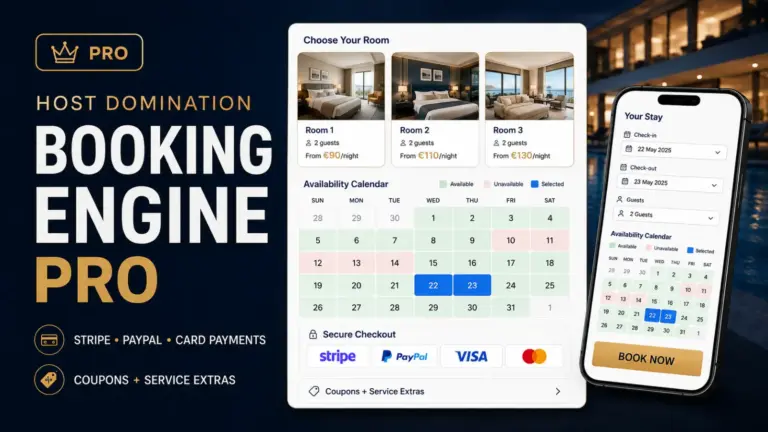
In this guide we will see How to get more direct bookings for a vacation rental, what features should have a good Booking Engine and how tools such as Host Domination Booking Engine allow you to manage most of these tasks directly from WordPress.
What is a vacation rental Booking Engine?
A Booking Engine is a reservation system that is installed or linked to the property’s website.
It allows the potential guest to:
- check the available dates;
- select check-in and check-out;
- indicate the number of guests;
- view the price of the stay;
- add any extra services;
- send a booking request;
- or complete the payment directly online.
In practice, it transforms the vacation rental website from a simple showcase to a real Direct sales channel.
If a user finds the property on Google, Instagram, Facebook or through word of mouth, it is no longer necessary to refer them to Booking.com or Airbnb.
You can book directly.
And this is precisely where one of the main advantages of a Booking Engine comes from.
Why increase direct bookings
OTAs remain extremely important in the tourism industry.
Booking.com and Airbnb, for example, allow a newly opened property to reach thousands of potential customers without having to immediately build its own marketing strategy.
The problem arises when 100% of bookings depend on external platforms.
Having your own Booking Engine allows you to gradually create a second channel.
Less commission on bookings
The first consequence is obvious.
A direct booking can significantly reduce intermediary costs.
Let’s say a stay has a value of €600.
If it is acquired through a platform that charges a significant commission, a part of the turnover is inevitably absorbed by the intermediary.
With a direct booking, on the other hand, the manager can keep a larger share of the value of the booking.
Out of dozens or hundreds of stays during the year, the difference can become significant.
The vacation rental website must become a sales tool
Simply having a site is not enough.
Many facilities still have sites consisting of:
- homepage;
- photographs;
- description of the structure;
- contact page;
- telephone number.
But at the decisive moment of booking, the user is invited to call, send an email or return to an OTA.
This creates friction.
An effective site should instead allow you to quickly switch from:
“I like this property”
a:
“Check if it’s available”
up to:
“I book”.
For this reason, the availability calendar and the Booking Engine should be central elements of the website of a holiday home.
Booking Engine and syncing with Airbnb and Booking.com
One of the main issues in managing direct bookings is availability.
If a night is booked on Airbnb, that same night should not be available on the site.
Otherwise, the risk of Overbooking.
One of the most popular solutions is synchronization via iCal.
The iCalendar format allows different platforms to exchange information about busy dates.
For example, you can connect:
- Airbnb;
- Booking.com;
- Vrbo;
- other iCal-compatible portals;
- the calendar of direct bookings on your site.
A really useful vacation rental Booking Engine should therefore also include calendar synchronization tools.
iCal Host Domination Booking Engine and Sync
Host Domination Booking Engine It was born with this logic.
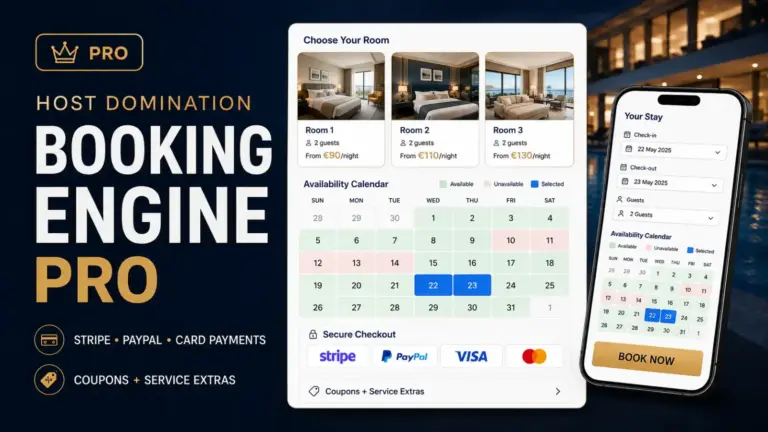
It is a WordPress plugin that allows you to create an availability and booking system directly within your site.
The free version already allows you to start managing a calendar and connect an external iCal source.
This means that even a small facility can create its own booking system without necessarily having to start with expensive management software.
For facilities with more advanced needs, a PRO version is also available with additional tools dedicated to managing multiple calendars, prices, payments and automations.
Free Booking Engine for vacation rentals: where to start?
One of the main obstacles for a small structure is the cost.
An owner who manages only one apartment may not need a complex PMS with dozens of functions from the start.
You may simply need:
- show a calendar;
- sync Airbnb or Booking.com;
- receive reservations;
- collect guest data;
- Control everything from a dashboard.
For this reason, it can be convenient to start with a Free Booking Engine and subsequently expand the system.
Host Domination Booking Engine has a FREE version designed to allow even small structures to create their own booking system on WordPress.
The approach is modular: you can start with the essential functions and later add more advanced tools when bookings and operational needs increase.
Booking Engine, PMS and Channel Manager: what are the differences?
These terms are often used synonymously, but they indicate different systems.
Booking Engine
The Booking Engine mainly allows you to receive direct bookings.
It then manages availability, dates, guests, prices and the booking process.
PMS
A Property Management System it is a broader management system.
It may include:
- reservations;
- calendar;
- guest management;
- collections;
- check-in;
- housekeeping;
- reporting;
- automations.
Channel Manager
The Channel Manager, on the other hand, is mainly used to synchronize availability, rates and reservations between different portals.
A true Channel Manager generally uses API connections with OTAs.
The iCal synchronization used by many Booking Engine is simpler and mainly concerns availability.
Can a Booking Engine offer similar functionality to a PMS?
Yes, at least for some activities.
Modern systems are progressively integrating tools that once belonged exclusively to PMSs.
Host Domination Booking Engine, for example, is not simply thought of as a calendar to be inserted into a WordPress page.
The dashboard allows you to have a centralized view of the property’s reservations and activities.
In the most advanced configurations, functions such as:
- management of reservations;
- multiple calendars;
- Planning View;
- advanced pricing;
- payment management;
- iCal synchronization;
- manual bookings;
- booking summaries;
- extra services;
- deposits;
- email automations;
- Mobile management.
This allows small and medium-sized structures in particular to concentrate many operations in a single interface.
A single dashboard to control bookings
As bookings increase, looking at Airbnb, Booking.com, email, and website separately can become impractical.
A centralized dashboard, on the other hand, allows you to have the situation immediately under control.
A good panel should show at least:
- recent bookings;
- upcoming stays;
- availability;
- origin of reservations;
- status of requests;
- Key economic data.
Host Domination Booking Engine uses a WordPress dashboard designed precisely to simplify this management.
The goal is to provide an interface closer to that of a small management system for accommodation facilities than to that of a simple calendar plugin.
Planning View: View all bookings
When managing multiple apartments, rooms, or properties, the traditional monthly calendar may not be enough.
A horizontal display similar to those used in hotel PMSs is much more effective.
The Planning View of Host Domination Booking Engine PRO allows you to view bookings on a timeline, organised by facility or calendar.
This allows you to quickly see:
- which properties are occupied;
- when stays begin and end;
- any free spaces between two reservations;
- where the bookings come from.
It is especially useful for property managers, B&B, landlords, and owners who manage multiple units.
Booking Engine optimized for smartphones
An important part of tourist bookings now takes place from mobile devices.
But mobile is not just about the customer.
The manager must also be able to quickly control the facility from his smartphone.
For this reason, Host Domination Booking Engine also pays special attention to the mobile use of the dashboard.
The PRO version can also be used through a Web App, creating a direct link on your phone to your most frequently used dashboard or sections.
The manager can then quickly access the system without having to manually navigate to the WordPress panel each time.
You can also use notifications for certain operational tasks, such as new requests or arrival-related information.
The result is an experience that is closer to that of a management app.
Online payments and direct bookings
Another important element concerns payment.
Not all facilities have the same needs.
Some prefer to simply receive a request and confirm it later.
Others want to allow the customer to pay immediately.
A Booking Engine should therefore allow for both approaches.
With Host Domination Booking Engine you can configure different booking methods and, in the PRO version, use online payment systems such as Stripe or PayPal.
This allows you to build a flow similar to that of large OTAs:
Search availability → select stay → enter data → payment → confirmation.
Booking request or instant booking?
Immediate payment is not always the best solution.
Let’s think, for example, of:
- villas;
- long stays;
- groups;
- structures that must verify particular conditions;
- custom requests.
In these cases, it may be more helpful to receive a request first.
The customer selects the dates and fills out the form, while the owner can verify the information before confirming.
For this reason, it is useful to choose a Booking Engine that does not necessarily force you to use only one sales model.
Seasonal prices and different rates
A vacation rental rarely uses the same price throughout the year.
A seaside property might have, for example:
- 90 € per night in April;
- 130 € per night in June;
- 200 € per night in August;
- 100 € per night in October.
The same goes for weekends, holidays or local events.
An advanced Booking Engine must therefore allow tariffs to be modified according to the period.
With the features of Advanced Pricing available in Host Domination Booking Engine PRO it is possible to configure different prices and build a more articulated tariff policy.
Prices according to the number of guests
Another frequent problem concerns the number of guests.
An apartment might have:
- a basic rate for 2 people;
- a supplement from the third guest;
- different conditions for children.
Using a fixed price can therefore make it difficult to represent your pricing policy correctly.
A more advanced booking system allows you to apply increments per additional guest and configure specific rules for children.
This logic makes it possible to bring the quote generated by the site closer to the calculation methods used by the large booking portals.
Sell extra services directly from the Booking Engine
Booking a room or apartment doesn’t have to be your only source of revenue.
During the booking process, additional services can be proposed.
For example:
- breakfast;
- parking;
- airport transfer;
- late check-out;
- early check-in;
- extra cleaning;
- cradle;
- pet services;
- experiences;
- rental.
Extras can increase the average value of each booking.
With an integrated system, the customer can select them directly during the booking process, avoiding subsequent conversations via WhatsApp or email.
Host Domination Booking Engine can also be extended with features dedicated to Service Extras, allowing you to build a progressively more complete booking system.
Advances and deposits
For larger stays, you may not need to immediately request payment for the entire stay.
An alternative is to request a deposit.
For example:
Total booking: 1.000 €
Online deposit: 300 €
Next balance: €700
This strategy can lower the barrier to purchase while also providing the property with a greater guarantee on the booking.
This is also one of the features that can be integrated into the Host Domination Booking Engine ecosystem.
Automated guest emails
Each booking generates a series of communications.
For example:
- request received;
- confirmed reservation;
- payment received;
- instructions before check-in;
- information about the stay;
- message before check-out;
- review request.
Managing them manually means repeating the same operations over and over again.
For this reason, the most advanced systems use automations.
Host Domination Booking Engine can be expanded with Guest Email Automation, allowing you to send communications to guests based on booking events.
This is a typical PMS feature that can be extremely useful even for a single vacation rental.
WordPress Booking Engine and Site
For those who use WordPress, having a Booking Engine directly integrated into the site has several advantages.
You don’t need to use a separate platform for each trade.
The owner can manage:
website + content + SEO + bookings
from the same ecosystem.
Host Domination Booking Engine is developed specifically for WordPress.
The calendar can then be inserted directly into the property pages and adapted to the booking flow of the site.
SEO and direct bookings: why they are linked
Installing a Booking Engine doesn’t automatically generate new bookings.
First you need to bring users to the site.
And that’s where SEO comes in.
A vacation rental should try to rank on Google not only for its own name, but also for searches related to the destination.
For example:
- holiday home in the center of Rome;
- Fiumicino airport apartment;
- holiday home near the Colosseum;
- seafront apartment Ostia;
- villa with pool Tuscany;
- apartment near Rome Fiumicino airport.
Each user who arrives directly on the site represents a potential customer who can avoid going through an OTA.
If the site has a Booking Engine, the path becomes:
Google → the property’s website → availability → direct booking.
This is the true value of combining SEO and Booking Engine.
Create pages dedicated to user searches
To get organic traffic, it is useful to create specific content.
Let’s say you manage an apartment near Fiumicino airport.
In addition to the main page of the structure, you could create articles such as:
- Where to sleep near Fiumicino airport;
- How to get from Fiumicino airport to the center of Rome;
- Parking near Fiumicino airport;
- What to see in Fiumicino;
- Where to sleep before an early morning flight from Fiumicino.
This content can intercept users who are planning their trip.
A button can be inserted within the pages:
Check availability
which leads directly to the Booking Engine.
Incentivize direct booking
To convince a user to book on the site, you have to give him a reason.
The direct rate can be accompanied by small advantages.
For example:
- best price available;
- free late check-out when possible;
- welcome drink;
- discounted parking;
- more flexible cancellation;
- Free upgrade subject to availability.
You don’t need to apply big discounts all the time.
Often, it is enough to clearly communicate the benefit of direct booking.
Recover customers who have already stayed
One of the most important benefits of direct bookings is the relationship with the customer.
A guest who has already stayed at the property may return.
If the only reference he remembers is Airbnb or Booking.com, he will probably book through the platform again.
For this reason, it is important to communicate the existence of the official website during your stay.
You can do this through:
- Welcome Book;
- QR Code in the apartment;
- post-stay emails;
- information ticket;
- WhatsApp;
- Wi-Fi landing page.
The message can be extremely simple:
For your next stay, check availability and offers directly on our official website.
In this way, a booking initially acquired through OTA can turn into a direct customer in the following years.
The Booking Engine must be simple
Each additional step can reduce conversions.
The ideal process should take a few steps.
1. Selecting dates
The customer chooses check-in and check-out.
2. Number of guests
Inserts adults and possibly children.
3. Quote
The system automatically calculates the stay.
4. Personal data
The customer enters the necessary information.
5. Booking
Submit a request or make the payment.
Simplicity is especially important on smartphones.
Why Host Domination Booking Engine can be interesting for a holiday home
The main advantage is the ability to start from a free system and progressively build a more complete environment.
The FREE version allows you to approach direct bookings without necessarily having to immediately face the costs of a traditional management software.
More advanced features can be added later.
Among the possibilities offered by the Host Domination ecosystem we find:
- booking calendar;
- iCal synchronization;
- dashboard;
- booking management;
- optimized mobile version;
- Web App;
- Planning View;
- multiple calendars;
- advanced pricing;
- online payments;
- extra services;
- advances;
- automated emails;
- custom rules;
- Booking summaries.
An environment is therefore created that, while starting from a Booking Engine WordPress, progressively incorporates several functions normally associated with PMS management systems.
Does a Booking Engine replace Booking.com and Airbnb?
Not necessarily.
And this probably shouldn’t be the initial goal.
OTAs represent an extraordinary acquisition channel.
The most balanced strategy is often:
OTA + official website + Booking Engine.
Booking.com and Airbnb can continue to generate visibility and new customers.
The official website instead becomes the channel through which:
- intercept Google traffic;
- collect direct bookings;
- recover regular customers;
- promote offers;
- progressively reduce dependence on commissions.
How to start increasing direct bookings
A concrete strategy can be developed in this way.
1. Create a professional website
The site must immediately convey reliability.
Professional photographs, clear information, reviews, and detailed descriptions are key.
2. Install a Booking Engine
The customer must be able to check availability immediately.
For a WordPress site, you can also start using it for free Host Domination Booking Engine.
3. Sync calendars
Connecting Airbnb, Booking.com, or other portals through iCal makes it easier to keep your availability aligned.
4. Configure pricing correctly
Seasonal rates, surcharges and extra services must be as consistent as possible with your commercial strategy.
5. Optimize your site for Google
Creating pages and articles dedicated to the destination allows you to increase organic traffic.
6. Promote your site to guests
Every customer acquired through OTA should know the official website of the structure.
7. Progressively automate management
When bookings increase, tools like Planning View, payments, automated emails, and web apps can reduce manual work.
How much can you save with direct bookings?
It mainly depends on the average value of bookings and the commissions normally paid to intermediaries.
Let’s take a purely indicative example.
A structure generates:
€50,000 annual bookings.
If a major part comes through portals that charge commissions, the annual cost of brokerage can easily become significant.
Suppose you can move even just the 20% of bookings on the official website.
It means obtaining:
€10,000 direct bookings.
Even without completely eliminating OTAs, reducing fees can therefore become attractive.
And it is precisely for this reason that the Booking Engine should be seen as an investment in the progressive commercial independence of the structure.
Booking Engine Holiday Homes: conclusions
Direct bookings are not achieved by simply installing a calendar on the site.
It is necessary to build a real ecosystem.
You need:
an effective website, an SEO strategy, a simple booking system, synchronized calendars, correct prices and good communication with guests.
The Booking Engine represents the technological heart of this strategy.
Solutions such as Host Domination Booking Engine allow you to start for free with the essential features and then evolve towards a more complete management, with tools that are increasingly reminiscent of those present in PMSs: centralized dashboard, Planning View, payments, automations, mobile management and multiple calendars.
The goal isn’t necessarily to eliminate Booking.com or Airbnb.
The goal is much more realistic:
Make sure that Booking.com and Airbnb aren’t the only channels through which a customer can book your property.
The more the traffic to the site grows, the more the possibility of transforming Google, social networks, word of mouth and regular customers into Direct bookings without intermediaries.
And every direct booking helps build a more autonomous, recognizable, and profitable business.