
The new structure of the Airbnb fees is leading many hosts to make a very simple calculation:
How much does Airbnb really cost me on each booking?
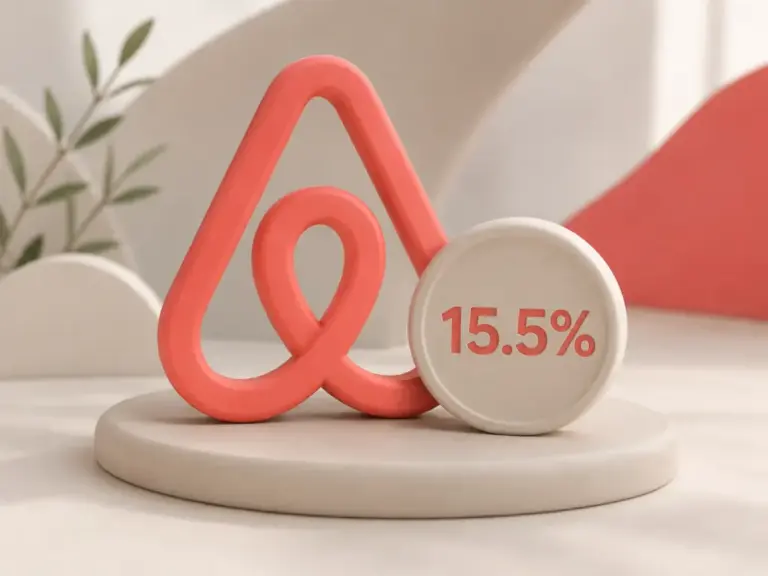
With the structure Single Fee, Airbnb indicates that the entire fee is deducted from the host’s payout, and that Most hosts pay 15.5%. For other hosts, the percentage is generally between 14% and 16%, with some exceptions.
15.5%, taken individually, may seem only a percentage.
However, when we transform it into euros, especially on dozens of bookings during the year, the result becomes much more evident.
So let’s see how much does a 15.5% commission really affect an Airbnb booking and because it can be useful for a host to combine OTAs with their own direct booking channel.
How does the 15.5% Airbnb fee work?
With the model Single Fee, the Airbnb fee is completely subtracted from the host’s payout.
Airbnb specifies that:
- Most hosts pay the 15,5%;
- Other hosts generally pay between 14% and 16%;
- There may be exceptions based on your country and account type.
The Single Fee is also mandatory for some categories of hosts, including traditional accommodation facilities and hosts that use certain property management software.
Airbnb also announced that hosts connected to property management or channel management software who have not yet switched to the new property will switch to Single Fee on October 13, 2026.
How much does the host have left with a 15.5% commission?
The calculation is very simple.
If the price of the reservation is:
€100
15.5% correspond to:
€15,50 VAT included
The remaining remuneration is therefore:
€84,50 VAT included
Airbnb uses this example in its official documentation: maintaining a price of 100 after switching to the Single Fee of 15.5%, the payout becomes 84.50.
But let’s see what happens with more realistic amounts.
How much does Airbnb hold on a booking?
Mathematically applying a fee of 15.5%:
| Reservation value | 15.5% commission | Remaining amount |
|---|---|---|
| €100 | €15,50 VAT included | €84,50 VAT included |
| €150 VAT included | €23,25 VAT included | Our price€126,75 VAT included |
| €200 | €31,00 VAT included | €169,00 VAT included |
| €300 | €46,50 VAT included | €253,50 VAT included |
| €500 | €77,50 VAT included | €422,50 VAT included |
| €750 VAT included | €116,25 VAT included | €633,75 VAT included |
| €1,000 | €155,00 VAT included | €845,00 VAT included |
| €1,500 | €232,50 VAT included | €1.267,50 VAT included |
| €2,000 | €310,00 VAT included | €1.690,00 VAT included |
These are mathematical examples based on a percentage of 15.5%.
The actual commission applied to a specific reservation may be different, and you should also consider any taxes and other components in your account.
But the figure allows us to immediately understand the economic weight of the commission.
Booking from €500
On a booking from €500:
€500 × 15.5% = €77.50
The remaining compensation is:
€422,50 VAT included
Booking from €1,000
On €1,000:
€1,000 × 15.5% = €155
The following remain:
€845 VAT included
Booking from €2,000
On a stay worth €2,000:
€2,000 × 15.5% = €310
The following remain:
€1.690 VAT included
And it is precisely when the average value and the number of bookings increase that the commission becomes an important economic item.
How much can Airbnb cost in a year?
Looking at a single booking is helpful.
Watching an entire year is even more so.
Let’s assume, for simplicity, that all bookings considered are subject to a 15.5% commission.
| Booking volume | 15,5% |
|---|---|
| €5,000 | €775 VAT included |
| €10,000 | €1.550 VAT included |
| €15,000 | €2.325 VAT included |
| €20,000 | €3.100 VAT included |
| €25,000 | €3.875 VAT included |
| €30,000 | €4.650 VAT included |
| €40,000 | €6.200 VAT included |
| €50,000 | €7.750 VAT included |
| €75,000 | €11.625 VAT included |
| €100,000 | €15,500 |
A host that generates, for example, €30,000 bookings through a channel with a commission of 15.5% would mathematically have:
€4,650 in fees.
On €50,000:
€7,750.
On €100,000:
€15,500.
The point is not that these amounts are necessarily “lost”.
Airbnb provides a service: it brings traffic, customers, visibility, payments and technological infrastructure.
The correct question for a host should be another:
Do I have to pay this commission on 100% of my bookings or can I also build a direct channel?
Is the solution to increase prices?
It is one of the possibilities.
Airbnb itself explains that, with the transition to Single Fee, hosts can change their rates to try to keep the payout unchanged.
In the official example, Airbnb compares a starting rate of 100 to an updated rate of 115.
With the previous system:
- host sets 100;
- the customer sees about 115 after their commission;
- The host receives approximately 97.
With the Single Fee:
- host sets 115;
- the customer sees 115;
- Airbnb subtracts the commission;
- The host receives approximately 97.
In other words, some of the change can be compensated for by changing the price.
But this poses another question.
How much can you raise the price before becoming less competitive?
If all costs are simply charged to the rate, the final price of the property can increase.
And the customer compares your ad to:
- other Airbnbs;
- Booking.com;
- hotels;
- B&B;
- sites of the structures;
- Google Hotels and other channels.
For this reason, relying solely on price increases is not necessarily the only strategy.
What if some of the bookings come directly?
This is where the reasoning gets interesting.
You don’t have to imagine deleting Airbnb.
Suppose that a structure generates:
€30,000 per year in bookings.
By simply applying 15.5%, we would have:
€4.650 VAT included
distribution cost.
Now let’s imagine that, over time, the owner manages to build his own channel and directly generate even just a part of his demand.
For example:
10% direct bookings
Out of €30,000:
€3,000 direct bookings
15.5% of €3,000 is equivalent to:
€465 VAT included
20% direct bookings
€6,000
15.5% is equivalent to:
€930 VAT included
30% direct bookings
€9,000
15.5% is equivalent to:
€1.395 VAT included
Please note: this does not automatically mean that a direct booking has Zero costs.
A website, Booking Engine, electronic payments, advertising, or other tools can come at a cost.
The advantage is another:
The host can start controlling a part of their sales channel directly, rather than buying each reservation through an external platform.
So is Airbnb too expensive?
It depends on the value it generates for the structure.
A commission can be absolutely affordable if Airbnb brings a booking that would never have arrived otherwise.
Let’s imagine an American tourist who doesn’t know your property.
Airbnb opens, search for “Rome”, find your apartment and book.
In that case, Airbnb played a fundamental role:
brought you a new customer.
The problem is different when a customer:
- already knows the name of the structure;
- Google you;
- find your site;
- from your site is sent back to Airbnb;
- book through Airbnb.
In this scenario, you’re using your site to bring a customer to an external platform.
And this is precisely one of the reasons why a Booking Engine on your website can become strategic.
The paradox of many vacation rental sites
Many owners already have a website.
But the path is:
Customer → the property’s website → “Book on Airbnb” → Airbnb
The site, therefore, is not really generating a direct booking.
It is advertising the ad on the OTA.
A site designed to sell should have a different path:
Customer → the site → choose the dates → check availability → book
The visitor remains within the proprietary channel.
What is a Booking Engine and why does it become important?
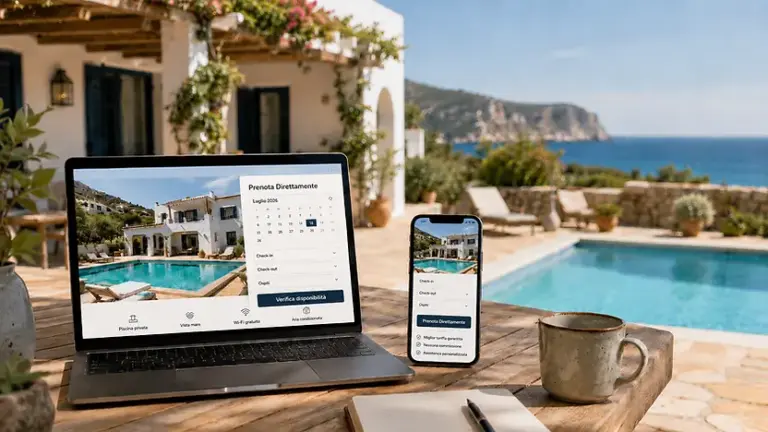
A Booking Engine is the software that allows a holiday home, B&B or accommodation facility to accept bookings through its website.
A customer can:
- choose the dates;
- check availability;
- select the number of guests;
- see the price;
- make a request;
- book;
- If necessary, make the payment online.
The site therefore goes from a simple showcase to:
sales tool.
Can I use Airbnb and my site at the same time?
Yes.
And it’s probably the most sensible strategy for many facilities.
You don’t have to choose between:
Airbnb or website.
You can use:
Airbnb + Booking.com + owner website
at the same time.
The key thing is to keep availability in sync.
Through calendar synchronization systems such as iCal, a booking received from one channel can also block dates in other connected calendars.
For example:
Airbnb → calendar
Booking.com → calendar
Direct site → calendar
In this way, the site can become an additional channel without necessarily giving up OTAs.
Already have a WordPress site?
If you already have a website for your vacation rental, you don’t necessarily need to do it again.
You can install a booking system such as Host Domination Booking Engine and add to the site:
- availability calendar;
- direct bookings;
- management of reservations;
- iCal synchronization;
- integration with Airbnb and Booking.com;
- management of multiple calendars;
- online payments in the features provided by the PRO version.
The goal is very simple:
Prevent a visitor who has already arrived on your site from having to leave and go to Airbnb to book.
Don’t have a website yet?
In this case, a proprietary site can become the central point of the online presence of the structure.
A vacation rental site should be designed not only to “be there,” but to convert.
It should include:
- photographs of the structure;
- descriptions;
- rooms or apartments;
- services;
- position;
- destination information;
- reviews;
- contacts;
- availability;
- online booking;
- link to OTA calendars;
- proprietary domain.
Host Domination realizes Websites for Hosts, B&B, and Vacation Rentals, with the possibility of integrating the booking system directly into the site.
How much does a Booking Engine have to cost to be affordable?
This is a calculation that every host can easily do.
Let’s say you have €20,000 in annual bookings.
A percentage of 15.5% is mathematically equivalent to:
€3,100.
If you can generate even €2,000 of new direct bookings through your website:
15.5% of €2,000 = €310.
On €5,000:
€775.
On €10,000:
€1,550.
This allows you to compare the cost of the tools needed to build a direct channel with the cost of distribution through platforms.
Of course, not all direct bookings necessarily replace an Airbnb booking, and the costs of the two models are not perfectly equivalent.
But it’s precisely this type of analysis that a host should start doing:
How much does it cost me to acquire a booking through each channel?
Airbnb is not the enemy: dependence on only one channel is the risk
The conclusion should not be:
“Don’t use Airbnb anymore.”
Airbnb can continue to play a fundamental role.
The most interesting model is:
Airbnb
to reach customers who do not yet know the structure.
Booking.com
to further increase distribution.
Google and proprietary site
to intercept those who search directly for the structure or destination.
Booking Engine
to turn site traffic into bookings.
The real strategy is therefore to diversify.
Conclusion: how much does a host really lose with 15.5%?
On a booking from:
- €100: €15.50;
- €500: €77.50;
- €1,000: €155;
- €2,000: €310.
On a volume of €30,000:
€4.650 VAT included
it is the mathematical result of the application of a percentage of 15.5%.
Airbnb indicates that with its Single Fee Most hosts pay 15.5%, while other hosts generally pay between 14% and 16%.
The question therefore is not necessarily:
“How do I stop paying Airbnb?”
The most useful question is:
“How can I make sure that Airbnb isn’t my only booking channel?”
The answer comes from the construction of a proprietary channel:
Website + Booking Engine + calendar synchronization + direct bookings.
Want to start booking directly?
If you already own a WordPress site you can use Host Domination Booking Engine to add a booking system and synchronize availability with your calendars.
If you don’t have a website yet, Host Domination creates sites dedicated to vacation rentals, B&B and hosts, designed to turn online traffic into direct bookings.
Use Airbnb to reach new guests. Build your direct channel so you don’t have to depend on Airbnb for every booking.
FAQ
Does Airbnb really take 15.5%?
With the Single Fee structure, Airbnb states that most hosts pay 15.5%; other hosts generally pay between 14% and 16%, with some exceptions.
How much does Airbnb keep on €500?
Applying a percentage of 15.5% to €500, the result is €77.50.
How much does Airbnb hold on €1,000?
15.5% of €1,000 is €155.
How much does Airbnb hold on €2,000?
15.5% of €2,000 equals €310.
Does Airbnb only calculate the commission on the cost of nights?
Airbnb explains that commissions are calculated as a percentage of the price of the nights plus any fees added by the host, such as the cost of cleaning.
Can I increase prices to offset the commission?
Yes. Airbnb itself illustrates the possibility of adjusting the rates to try to keep the payout unchanged after the transition to the Single Fee.
Can I get bookings from my site and still use Airbnb?
Yes. You can continue to use Airbnb and other portals in parallel with the owner site, keeping your availability in sync through the appropriate tools.
How can I get bookings directly from my WordPress site?
You can install a Booking Engine that allows the customer to check availability and book directly from the site. Host Domination Booking Engine is designed to add these features to WordPress.