
The Airbnb fees in 2026 They are one of the most important topics for those who manage a holiday home, a B&B, a tourist apartment or an accommodation facility.
Airbnb is in fact progressively simplifying its commission structure through the model Single Fee, where the commission is fully deducted from the host’s payout.
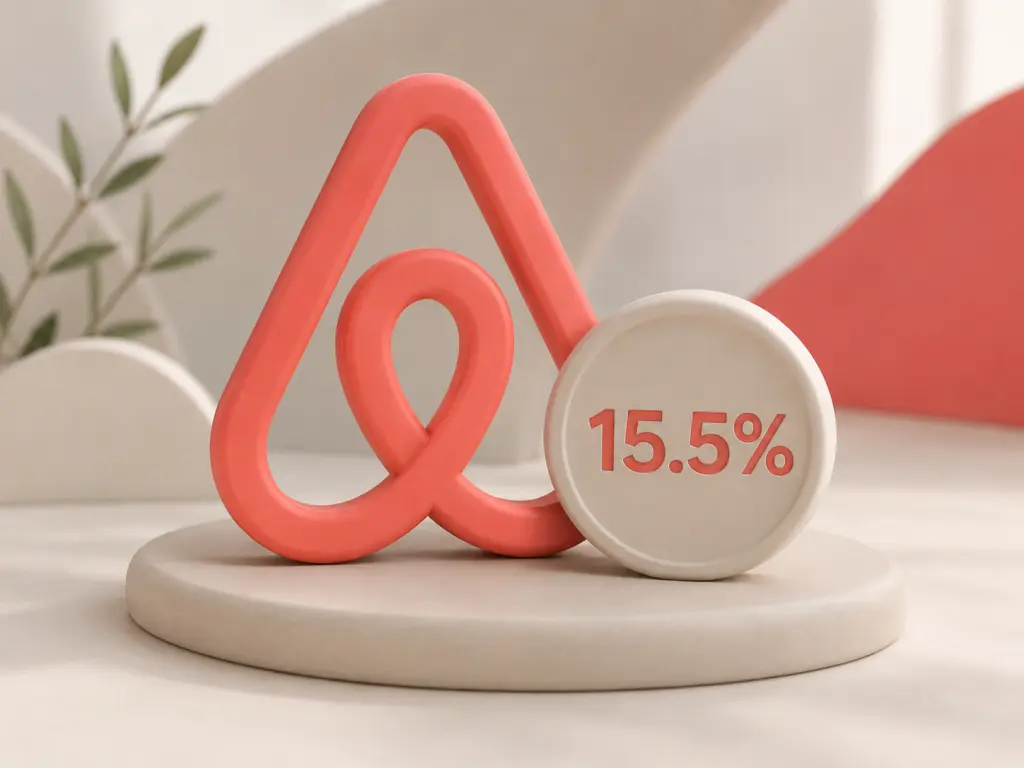
According to official Airbnb documentation, with the Single Fee structure Most hosts pay 15.5%, while for other hosts, the percentage is generally between 14% and 16%.
This change makes one question even more important:
Is it better to continue to depend exclusively on Airbnb or is it time to build your own direct booking channel as well?
Let’s see how it works.
How do Airbnb fees work in 2026?
Airbnb primarily distinguishes between two commission models:
- Split Fee
- Single Fee
In the old Split Fee model, the commission is split between host and guest.
Most hosts with this system pay about 3%, while the guest generally pays a commission between 14.1% and 16.5% of the reservation subtotal.
With the model Single Fee, however, the mechanism changes.
The commission is fully deducted from the host’s payment.
Airbnb indicates that:
most hosts pay 15.5% with the Single Fee.
For other hosts, the percentage is generally between 14% and 16%, with some exceptions.
What does a 15.5% Airbnb fee mean?
Let’s take a very simple example.
Let’s say a booking has a value of:
€100
Applying a 15.5% fee:
€100 × 15.5% = €15.50
The host is left with:
€84,50 VAT included
Airbnb uses this example in its documentation: maintaining a price of 100 with the Single Fee at 15.5%, the compensation after the commission becomes 84.50.
Obviously this is a simplified example and does not consider any taxes, additional costs or other variables.
But it allows you to immediately understand how much a percentage commission can affect your margin.
How much can 15.5% cost in a year?
This becomes even more evident when we apply it to the total revenue generated through Airbnb.
| Bookings generated | 15,5% |
|---|---|
| €1,000 | €155 VAT included |
| €5,000 | €775 VAT included |
| €10,000 | €1.550 VAT included |
| €20,000 | €3.100 VAT included |
| €30,000 | €4.650 VAT included |
| €50,000 | €7.750 VAT included |
| €100,000 | €15,500 |
These numbers simply represent the mathematical result of applying a percentage of 15.5%.
The actual fee applied to your Airbnb account may be different.
The point, however, is clear:
the more the turnover generated through an OTA increases, the higher the cost of distribution becomes.
Does the 15.5% fee apply to all Airbnb hosts?
No.
It is important to clarify this point.
It would not be correct to say that all Airbnb hosts automatically pay 15.5%.
Airbnb continues to document both the Split Fee model and the Single Fee model.
With the Single Fee, however, the entire fee is borne by the host, and Airbnb indicates the 15.5% as the rate applied to most affected hosts.
Single Fee is also required in certain situations, including some traditional hospitality operators and hosts using property management software.
Airbnb has also announced that hosts who use property management software and who have not yet switched to Single Fee will make the switch on October 13, 2026.
It is therefore always advisable to directly check the breakdown of the commissions applied to your reservations in your Airbnb account.
Does Airbnb recommend raising prices?
To compensate for the transition to Single Fee, Airbnb provides tools to change prices.
The principle is simple.
If you used to set a price of €100 and the customer, after the additional commissions, saw a higher price, with the Single Fee you can incorporate part of the cost directly into the rate.
Airbnb shows, for example, a scenario in which a price previously set at 100 is raised to 115: the customer continues to see 115 while the host retains a payout similar to the previous one.
But raising prices is not the only possible strategy.
There is another way for a host:
progressively reduce dependence on external platforms by also developing direct bookings.
So should we abandon Airbnb?
Absolutely not.
Airbnb can be an extremely important channel for obtaining:
- visibility;
- new customers;
- international bookings;
- reviews;
- demand in low season.
The problem arises when Airbnb becomes the only channel through which a property can sell.
An accommodation business should instead think of Airbnb as one of its distribution channels.
The strategy can be:
Airbnb + Booking.com + owner website + direct bookings
instead of:
Airbnb and that’s it.
Why create a vacation rental website?
A proprietary site allows the facility to build a channel that it controls directly.
A customer can find the property through Google, social networks, Google Maps, word of mouth or a previous booking and arrive directly on the site.
The problem is that many vacation rental sites today work like this:
Google → property site → “Book on Airbnb” button → Airbnb
In practice, the owner bears the cost of the site but then still refers the customer to an external platform to complete the booking.
A really useful site should instead allow a path like this:
Google → the property’s website → check availability → booking → confirmation
And that’s where the Booking Engine.
What is a Booking Engine?
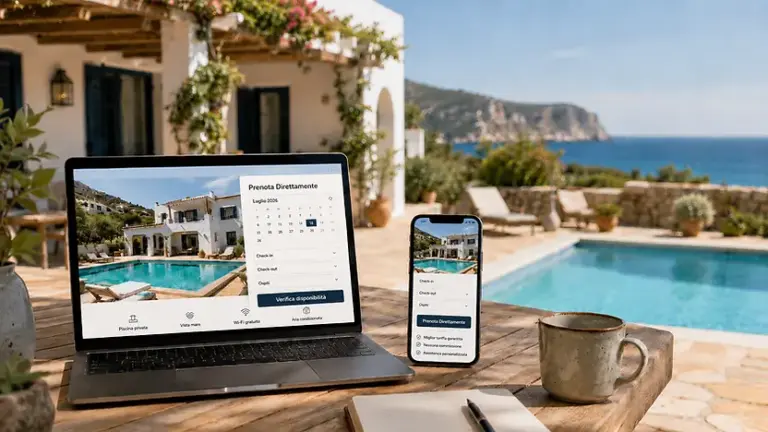
A Booking Engine is the system that allows you to transform a normal website into a real booking site.
The customer can:
- select check-in and check-out;
- check availability;
- indicate the number of guests;
- view the price;
- send a booking request;
- make a direct booking;
- If necessary, pay online.
In this way, the site is no longer just a showcase.
Become a real Direct sales channel.
Already have a WordPress site? You don’t necessarily have to do it again
If you already have a WordPress site for your apartment, B&B or vacation rental, you can add a booking system directly.
With Host Domination Booking Engine you can turn your WordPress site into a system to receive direct bookings and synchronize availability via iCal calendar.
This allows you to use several channels at the same time:
Airbnb ↔ Booking.com ↔ website
Syncing bookings to reduce the risk of overbooking.
The goal is not to eliminate Airbnb.
The goal is to ensure that Airbnb isn’t the only place a customer can book your property.
Don’t have a website yet?
In this case, 2026 may be the right time to start building a proprietary channel.
A good vacation rental site should include at least:
- proprietary domain;
- professional photographs;
- description of the structure;
- services;
- location and information about the area;
- reviews;
- contacts;
- availability;
- booking system;
- link to Airbnb and Booking.com calendars;
- possibility to receive direct bookings.
Host Domination realizes Websites designed specifically for hosts, B&B, and vacation rentals, with the possibility of directly integrating the Booking Engine.
The real benefit of direct bookings: building your own channel
The difference is not just about the fees.
When you build a proprietary site, you’re creating an asset that stays with your business.
A guest who has already stayed at the property could, for example, return the following year.
If they only know your Airbnb listing, they’ll likely come back to find you on Airbnb.
If, on the other hand, he knows:
can go directly back to your site.
The same goes for:
- Google;
- business cards;
- QR code;
- Instagram;
- Facebook;
- WhatsApp;
- email;
- regular customers;
- word of mouth.
Each channel can direct the customer to a booking system that directly controls.
Airbnb or direct bookings? The best strategy is to use both
Pitting Airbnb and the owner site against each other is probably the wrong approach.
Airbnb can be extremely effective at acquiring new customers.
A proprietary site, on the other hand, can help you develop your brand and progressively increase the weight of direct bookings.
A more balanced strategy can be:
OTA to gain visibility + website to build independence in the long run.
In other words:
use Airbnb to get found, but build your site to not depend solely on Airbnb.
Conclusion
The new structure of the Airbnb fees in 2026 It makes it even more important to know exactly how much each sales channel costs.
With the Single Fee, Airbnb indicates that most interested hosts pay a commission of 15.5% fully deducted from the host’s payout, while others generally pay between 14% and 16%.
Airbnb will certainly continue to be an important sales tool for thousands of properties.
But completely depending on a single platform means also depending on its fees, rules, and future changes.
For this reason, it can be useful to build your own channel in parallel:
website + Booking Engine + Airbnb sync and Booking.com + direct bookings.
Do you want to receive bookings directly from your website?
If you already have a WordPress site you can install Host Domination Booking Engine and turn it into a direct booking system.
If you don’t have a website yet, Host Domination can create a complete website for your vacation rental, B&B or apartment, set up to receive online bookings and synchronize with the main portals.
Airbnb can bring you new customers. Your site can turn them into your business’s assets.
Airbnb Fees FAQs 2026
How much does Airbnb withhold from hosts in 2026?
It depends on the fee structure applied. With the Single Fee, Airbnb states that most hosts pay 15.5%; other hosts generally pay between 14% and 16%.
Is the 15.5% Airbnb fee paid by the host?
In the Single Fee model, yes: the entire commission is deducted from the host’s compensation.
Do all Airbnb hosts pay 15.5%?
No. Airbnb still documents different licensing structures, and there may be different percentages and conditions depending on the host and account type.
How much does the host have left on 100 euros with a 15.5% commission?
In a purely mathematical calculation, a 15.5% fee on €100 equals €15.50, leaving €84.50 before considering any other costs or taxes.
How can I reduce my reliance on Airbnb fees?
One possibility is to develop a direct booking channel in parallel through a proprietary website equipped with Booking Engine.
Can I continue to use Airbnb if I receive bookings from my site?
Yes. Airbnb, Booking.com, and the owner site can be used at the same time. It’s important to sync your calendars correctly to reduce the risk of overlapping bookings.
Can I add a Booking Engine to an existing WordPress site?
Yes. With a system like Host Domination Booking Engine You can add booking functionality to an existing WordPress site without necessarily having to build a new site.