
Channel Manager or Booking Engine? If you’re running a vacation rental, a tourist apartment, or a small B&B, it’s easy to think that you need both.
In reality, not all facilities need a Channel Manager, especially if they manage one or a few listings and work primarily with Airbnb, Booking.com, and their own website.
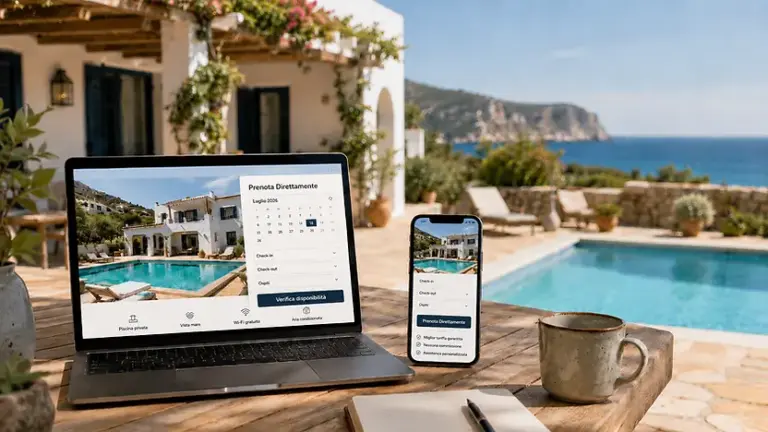
In many cases, the real tool that is missing is a Booking Engine, i.e. a system that allows guests to check availability and book directly from the property’s website.
The difference is important.
A Channel Manager it is primarily used to distribute and synchronize availability, rates, and other information among numerous OTAs.
A Booking Engine, on the other hand, serves to transform your site into a real Direct booking channel.
For a small holiday home, therefore, before subscribing to expensive management software or a Channel Manager with a recurring subscription, it is worth asking yourself:
Do I really need to manage dozens of channels, or do I just want to get more bookings directly from my website?
In this guide we see when you need a Channel Manager, when a Booking Engine is enough, and why for many hosts, a free Booking Engine can be the most cost-effective place to start.
Booking Engine and Channel Manager are not the same thing
Before choosing, you need to understand what they really do.
We can simplify as follows:
BOOKING ENGINE → book from your website
CHANNEL MANAGER → synchronizes and distributes the structure on OTAs
They are therefore different tools.
In some cases, they are used together.
In others, especially in smaller facilities, A calendar synchronization Booking Engine can already cover most of your operational needs.
What is a Booking Engine?
A Booking Engine It is a booking system installed or integrated into the facility’s website.
It allows the guest to:
- enter the site;
- check available dates;
- select the accommodation;
- indicate the number of guests;
- know the price;
- send an enquiry or make a booking;
- If necessary, pay online.
The path becomes:
Google / Social / Word of mouth
↓
Property website
↓
Check availability
↓
Direct booking
The goal is therefore very different from that of a Channel Manager.
The Booking Engine is mainly used to Developing the direct channel.
What is a Channel Manager?
A Channel Manager It is software designed to connect a facility to multiple sales channels.
For example:
Airbnb
Booking.com
Expedia
Vrbo
Agoda
↓
CHANNEL MANAGER
↓
Availability, Pricing & Restrictions
When a booking is made on one of the portals, the Channel Manager can update the other connected channels.
In the most complete systems, it can synchronize elements such as:
- availability;
- prices;
- inventory;
- minimum stay;
- restrictions;
- pricing plans;
- closures;
- Changes to reservations.
It is therefore a very useful tool.
But that doesn’t mean that Every vacation rental owner needs it.
The correct question is not “which is better?”
Booking Engine and Channel Manager solve different problems.
The correct question is:
What problem do I need to solve in my facility?
If your problem is:
“I am present on 8 portals and I have to change prices, availability and restrictions at the same time”
you probably need a Channel Manager.
If, on the other hand, the problem is:
“I have Airbnb and Booking.com, but I can’t get bookings from my website”
probably the priority should be a Booking Engine.
And this is where many small hosts end up buying more complex tools than necessary.
When you do NOT necessarily need a Channel Manager
Let’s imagine a very common situation.
Manage:
- 1 holiday home;
- Airbnb;
- Booking.com;
- a WordPress site.
You therefore have:
Airbnb + Booking.com + website
The main problem is not necessarily to distribute the accommodation on ten other portals.
It could be just the opposite:
you’re already getting enough exposure from OTAs, but you’re completely dependent on them to get bookings.
In this case, simply adding another distribution software does not automatically increase direct bookings.
It might make more sense to invest in your site.
The limit of a site without Booking Engine
Many owners already have a website.
But the site often contains only:
- photographs;
- description of the structure;
- services;
- position;
- telephone number;
- WhatsApp button;
- contact form.
The guest arrives on the site but cannot immediately verify:
“Is it available from August 10 to 15?”
He has to write.
Wait.
Receive a response.
Ask for the price.
Wait a little longer.
In the meantime, you can simply open Airbnb or Booking.com and book there.
A Booking Engine eliminates much of this friction.
The Booking Engine turns the site into a sales channel
With a Booking Engine the site goes from:
Showcase site
a:
Bookable site
The guest can see:
availability → dates → price → guests → request/booking
directly from the site.
This is especially important for those who want to progressively reduce dependence on Airbnb and Booking.com.
OTAs can continue to be used to gain visibility.
But the owner builds his own channel at the same time:
Airbnb / Booking.com = acquisition
Proprietary site = direct booking
Why can the Booking Engine be more important for a holiday home
Let’s consider two investments.
Option A: Add a Channel Manager
Get more centralized OTA management.
But the guest mainly continues to book through:
- Airbnb;
- Booking.com;
- other portals.
Option B: Add a Booking Engine
Your site becomes capable of generating:
Direct bookings
This means building a proprietary asset.
The site can be found via:
- Google;
- SEO;
- Google Business Profile;
- Instagram;
- Facebook;
- advertising campaigns;
- existing customers;
- word of mouth;
- email;
- WhatsApp.
And all of these sources can lead the guest to a page where they can check availability directly.
Channel Manager vs. Booking Engine: Comparison
| Function | Booking Engine | Channel Manager |
|---|---|---|
| Receive bookings from your website | ✅ | Not the main function |
| Show availability on the site | ✅ | It depends on the system |
| Show prices on the site | ✅ | It depends |
| Reduce reliance on OTAs | ✅ | Indirectly |
| Sync multiple OTAs | Limited / iCal | ✅ |
| Sync pricing between OTAs | ❌ normally | ✅ |
| Sync restrictions | ❌ normally | ✅ |
| Managing many OTAs | ❌ | ✅ |
| Sync iCal calendars | ✅ if supported | Often ✅ |
| Driving direct bookings | ✅ | Not the main purpose |
| Necessary for 1 out of 2 apartment OTAs | Not necessarily | Not necessarily |
This table makes it clear why there is no absolute best tool.
It depends on the structure.
Do you only have one vacation rental? You probably start from the Booking Engine
Let’s say you manage only one apartment.
You are present on:
Airbnb
e
Booking.com
and you also own:
hostmiosito.it
In such a simple setup, immediately purchasing infrastructure designed to deploy dozens of units across many OTAs can be oversized.
Instead, you can build:
AIRBNB ───────┐
              │
BOOKING.COM ──┼── disponibilità
              │
SITO WEB ─────┘
using, when compatible with the systems involved, the synchronization of calendars through iCal / ICS.
The site can thus have its own Booking Engine while Airbnb and Booking.com continue to be used as sales channels.
Example: A vacation rental with Airbnb and Booking.com
Let’s imagine:
Holiday Home Rome Center
on Airbnb and Booking.com.
The owner also has a WordPress site.
You can install a Booking Engine and configure:
Airbnb → calendar site
Booking.com → calendar site
and manage the export of availability to compatible platforms.
The result is:
           AIRBNB
              ↕
        BOOKING ENGINE
              ↕
          BOOKING.COM
At this point the owner also has:
www.casavacanzeroma.it → BOOK
and is not obliged to send each visitor to an OTA to complete the booking.
Host Domination Booking Engine: leave for free
It is precisely for this type of scenario that it was developed Host Domination Booking Engine.
It’s a WordPress plugin designed for vacation rentals, apartments, B&B, and independent hosts who want to add a booking system directly to their site.
The free version allows you to get started with the essential features of direct booking:
- availability calendar;
- booking requests from the site;
- price per night;
- minimum stay;
- guest data;
- booking dashboard;
- responsive module;
- synchronization with an external calendar via iCal / ICS.
Host Domination also explicitly indicates the compatibility of external calendars with platforms such as Airbnb, Booking.com and Vrbo.
👉 Host Domination Booking Engine:
https://hostdomination.com/booking-engine/
Why start with a free Booking Engine
For a small host, the advantage is simple:
You can check if the Direct Channel is working before adding more complexity and recurring costs.
The path can be:
Step 1
WordPress Site
↓
Step 2
Free Booking Engine
↓
Step 3
Connected Airbnb / Booking.com calendars
↓
Step 4
First direct requests
↓
Step 5
Advanced features only when you need them
It’s a modular approach.
You don’t need to start immediately with the most complex software available.
Can a free Booking Engine really be enough?
It depends on what you need to do.
If you want to:
- show availability;
- allow you to choose dates;
- receive requests directly from the site;
- show a price per night;
- set a minimum stay;
- connect an external calendar;
then Host Domination Booking Engine Free can already cover these basic needs.
If the structure grows later, you can add more features.
What if I want online payments and advanced features?
At that point, you don’t necessarily have to switch platforms completely.
Host Domination Booking Engine also has a PRO version.
It currently adds, among other functions:
- online payments with Stripe;
- multiple calendars;
- multiple iCal connections;
- unified iCal calendar;
- advanced pricing per day or month;
- blocking of individual dates or months;
- booking management tools;
- optional add-ons.
The PRO version is therefore designed for those who start from a simple management and then want to make their booking system more complete.
From the showcase site to the booking system
This is probably the most important aspect.
Having a website does not automatically mean having a Direct Channel.
A site can receive 1,000 visitors.
But if the only button available is:
“See the structure on Booking.com”
You’re simply using your site to send the customer back to an intermediary.
With a Booking Engine the path changes:
↓
your site
↓
Availability
↓
Price
↓
Booking
The customer stays within your ecosystem.
Direct booking also means building your own brand
OTAs are extremely important for visibility.
The point is not necessarily to eliminate them.
A more balanced strategy can be:
use Airbnb and Booking.com to be found and at the same time develop their own direct channel.
This allows the structure to build over time:
- its own domain;
- Google positioning;
- reviews and reputation;
- organic traffic;
- recurring customers;
- customer database;
- advertising campaigns;
- Direct bookings.
The Booking Engine then becomes a part of the facility’s digital infrastructure.
Why pay for a Channel Manager if you don’t use its features?
This is where an economic assessment must be made.
A Channel Manager can be a great investment when it’s actually used.
But if you have:
1 apartment + Airbnb + Booking.com
If you only use the software to keep the same dates busy on the two portals, you have to ask yourself if you really need all the additional features.
You could use:
iCal sync
Booking Engine on your site
and invest more in the direct channel.
It doesn’t mean that a Channel Manager is useless.
It simply means that The cost and complexity must be proportionate to the real needs of the structure.
When the Channel Manager is really needed
There are situations in which the discourse changes completely.
Suppose you manage:
- 20 apartments;
- Airbnb;
- Booking.com;
- Expedia;
- Vrbo;
- Agoda;
- other portals.
And to continuously modify:
- prices;
- minimum stays;
- availability;
- restrictions;
- pricing plans.
At that point, working only through iCal becomes inefficient.
In such a scenario, a Channel Manager can be very useful.
The central system can distribute the changes to the different channels.
Example: when to choose the Channel Manager
You have:
15 apartments
Published on:
Airbnb + Booking.com + Expedia + Vrbo
Each week you change:
- prices;
- restrictions;
- minimum stay;
- availability.
Here the main problem is:
Multi-channel distribution
The correct choice is probably:
CHANNEL MANAGER
Example: When to choose the Booking Engine
You have:
1-3 apartments
Mainly published on:
Airbnb + Booking.com
and you have a WordPress site.
Your goal is:
- receive direct bookings;
- show availability;
- avoid referring every customer to OTAs;
- synchronize busy dates;
- have more control over the relationship with the guest.
Here I would start from:
BOOKING ENGINE
Example: when you need both
You have:
10 apartments
many OTAs
many direct bookings
At this point, the two needs coexist.
You need:
Channel Manager
to distribute and synchronize channels,
e:
Booking Engine
to receive reservations on the site.
The structure can therefore become:
AIRBNB ────────┐
BOOKING.COM ───┤
EXPEDIA ───────┼── CHANNEL MANAGER
VRBO ──────────┘
                      ↕
                BOOKING ENGINE
                      ↕
                   SITO WEB
In this case, the two instruments are not alternatives.
They are complementary.
Booking Engine, Channel Manager, or both?
We can summarize it like this.
Primarily choose a Booking Engine if:
- you manage one or a few properties;
- you use few OTAs;
- you own a site;
- you want to receive direct bookings;
- you want to show availability on the site;
- all you need is an iCal calendar synchronization;
- You want to start with reduced costs.
Evaluate a Channel Manager if:
- you manage many facilities;
- you use numerous OTAs;
- you need to sync prices;
- you need to sync restrictions;
- you make many changes;
- you have high volumes of bookings;
- iCal is no longer enough.
Use both if:
- you have an organized structure;
- you want multi-channel distribution;
- you want to develop direct booking at the same time.
The problem with OTA fees
Another element to consider is the business model.
A booking obtained through an OTA remains an intermediated booking.
When the customer books from your site:
The acquisition channel is yours.
This makes it especially important to work on:
- SEO;
- website;
- Google Business Profile;
- campaigns;
- social media;
- recurring customers;
- Booking Engine.
The Channel Manager optimizes above all How you manage channels.
The Booking Engine instead contributes to creating a proprietary sales channel.
It is a strategic difference.
Host Domination Booking Engine and WordPress
If you already have a WordPress site, you can add Host Domination Booking Engine directly to the site.
The free version allows you to create the first direct booking flow without necessarily having to purchase an external management system from the beginning.
The guest can:
open the site
↓
See availability
↓
Choose dates
↓
view price
↓
Send Inquiry
The Host Domination site describes the plugin as a WordPress solution for receiving direct requests and keeping external calendars coordinated via iCal/ICS.
👉 https://hostdomination.com/booking-engine/
And if in the future the structure grows?
You don’t have to choose the software you might need in five years today.
You can start from the current need.
For example:
Today
1 bedroom apartment
↓
Airbnb + Booking.com
↓
Booking Engine Free
Tomorrow
3 apartments
↓
Booking Engine PRO
↓
More calendars + payments
Later
20 apartments + numerous OTAs
↓
Channel Manager
Booking Engine
This avoids building an oversized infrastructure from the start.
iCal is not a Channel Manager though
It is important not to confuse the two.
A Booking Engine that imports calendars using iCal can keep the Busy dates, but it does not automatically become a Channel Manager.
iCal is not normally used to synchronize:
- OTA fees;
- promotions;
- advanced restrictions;
- inventory;
- pricing plans.
So:
Booking Engine + iCal ≠ Full Channel Manager
For many small holiday homes this may not be a problem.
For a complex structure, however, it can become so.
The cheapest solution is not always the cheapest
You also need to evaluate how much you really use a tool.
A €50 per month software used fully can be an excellent investment.
A €20 per month software of which you only use one feature could be an unnecessary expense.
The question should therefore be:
What features do I need today?
Do not:
What is the most complete software?
For an independent holiday home, the initial needs often are:
Availability + website + direct bookings + synchronized calendar.
And it is exactly the territory of a Booking Engine.
Can a Booking Engine help you depend less on Booking.com?
Yes, but not automatically.
Installing a Booking Engine is only the first step.
Next you have to bring users to the site through:
- SEO;
- Google;
- Google Business Profile;
- social media;
- advertising;
- word of mouth;
- existing customers.
However, the Booking Engine allows you to Convert that traffic into direct requests and bookings.
Without a booking system, you risk investing in the site and then sending the visitor to an OTA anyway.
Is it better to delete Airbnb and Booking.com?
No.
For many facilities it would be a counterproductive choice.
Airbnb and Booking.com can be excellent acquisition tools.
A smarter strategy is often:
OTA + Direct Channel
and not:
OTA or direct channel
You can continue to leverage the visibility of the platforms as you progressively build your site and brand.
The ideal configuration for a small holiday home
For many independent hosts, a simple setup can be:
AIRBNB
    ↕
BOOKING.COM
    ↕
SITO WORDPRESS
    +
BOOKING ENGINE
The site becomes the center of the direct channel.
OTAs remain distribution tools.
Calendars are coordinated through available systems.
And only when management becomes more complex do you add a Channel Manager.
Frequently Asked Questions
Is it better to channel manager or Booking Engine?
It depends on the goal. If you want to receive bookings directly from the site, you mainly need a Booking Engine. If you need to manage and synchronize numerous OTAs, prices, and restrictions, a Channel Manager is more suitable.
Does a vacation rental need a Channel Manager?
Not necessarily. A vacation rental on a few platforms can manage availability through iCal synchronization. The need for a Channel Manager increases with the number of properties, channels and rules to be synchronized.
Can I use Airbnb and Booking.com without Channel Manager?
Yes. The platforms support calendar synchronization systems that can be used in compatible configurations. However, you should be aware of the limitations of iCal, especially since it is not a complete synchronization of prices and restrictions.
What is most important for getting direct bookings?
The Booking Engine. It allows users who arrive on the site to check availability and start a booking without having to be redirected to an OTA.
Is there a free WordPress Booking Engine?
Yes. Host Domination Booking Engine has a free version for WordPress with availability calendar, direct requests, price per night, minimum stay and synchronization of an external calendar via iCal/ICS.
Host Domination Booking Engine does it work with Airbnb and Booking.com?
The plugin supports the import and synchronization of external iCal/ICS calendars and indicates compatibility with calendars from Airbnb, Booking.com and Vrbo.
Does Booking Engine also sync Airbnb and Booking.com prices?
No. Synchronization via iCal is primarily about availability and calendar events. To synchronize rates and restrictions between different OTAs, you normally need a Channel Manager or a specific integration.
Can I use Booking Engine and Channel Manager together?
Yes. For larger properties, it is often the most complete configuration: the Channel Manager manages OTAs while the Booking Engine collects direct bookings from the site.
When should I switch to a Channel Manager?
When the number of properties or platforms increases to the point that manually updating rates, restrictions, and availability becomes inefficient or risky.
Conclusion: Don’t buy complexity you don’t need
Channel Manager and Booking Engine are not direct competitors.
They solve two different problems.
The Channel Manager is very useful when you need to manage a complex deployment across numerous OTAs.
But if you own one or a few vacation homes and your main goal is:
- receive direct bookings;
- enhance the site;
- show availability;
- synchronize calendars;
- progressively reduce dependence on OTAs;
you may not need to start with an expensive Channel Manager.
It can make much more sense to start with a Free Booking Engine, see how much you can generate from your site, and only add more advanced tools when they become really necessary.
With Host Domination Booking Engine you can get started for free on WordPress and transform your site from a simple storefront to a real channel for direct bookings.
Airbnb and Booking.com continue to bring you visibility.
Your site starts bringing you bookings.
👉 Download Host Domination Booking Engine for free:
https://hostdomination.com/booking-engine/
Recommended SEO settings
SEO Title:
Channel Manager or Booking Engine for vacation rentals? Which one to choose
Meta description:
Channel Manager or Booking Engine? Find out which one a vacation rental really needs and when you can avoid expensive management by using a Booking Engine.
Slug:channel-manager-o-booking-engine-case-vacanza
Main keyword:
Channel Manager or Booking Engine
Secondary keywords:
- Booking Engine or Channel Manager
- Channel Manager Vacation Rentals
- booking engine holiday homes
- You need a channel manager
- Airbnb Booking channel manager
- Booking Engine Airbnb Booking
- Free Booking Engine
- WordPress booking engine
- Holiday home booking system
- direct bookings holiday homes
- sync Airbnb Booking site
- alternative Channel Manager
- Economical Channel Manager
- Vacation Rental Booking Management
- Booking Engine for Apartments
- vacation rental booking software
Recommended category:
Resources for Host → Booking Engine
Excerpt:
Channel Manager or Booking Engine? For many holiday homes with one or a few properties, an expensive Channel Manager may not be necessary. Let’s see when to choose one, when to choose the other and how to get started with a Booking Engine for free.